I have to admit I slept pretty well at the Lagos Travel Inn. I had a dinner of roasted chicken and chips (= fries, I indulged), watched some Yoruba dramas and a film with Brittany Murphy and surfed via the free wifi. The power went out a few times and the generator was promptly turned on. Gotta love the gent that I don't have to get up and go out to turn on! The only thing I couldn't figure out was how to adjust the air conditioner. Later, I figured out that I couldn't adjust the settings and only could turn on or turn off the AC. Thus, I slept in long sleeves and long pants tugging on all the blankets all night. Plus, no bugs I could see!After eating a basic but free breakfast, our driver took us to our new hotel, White House.Here is my room. I will need to take a picture of the complex itself before leaving.
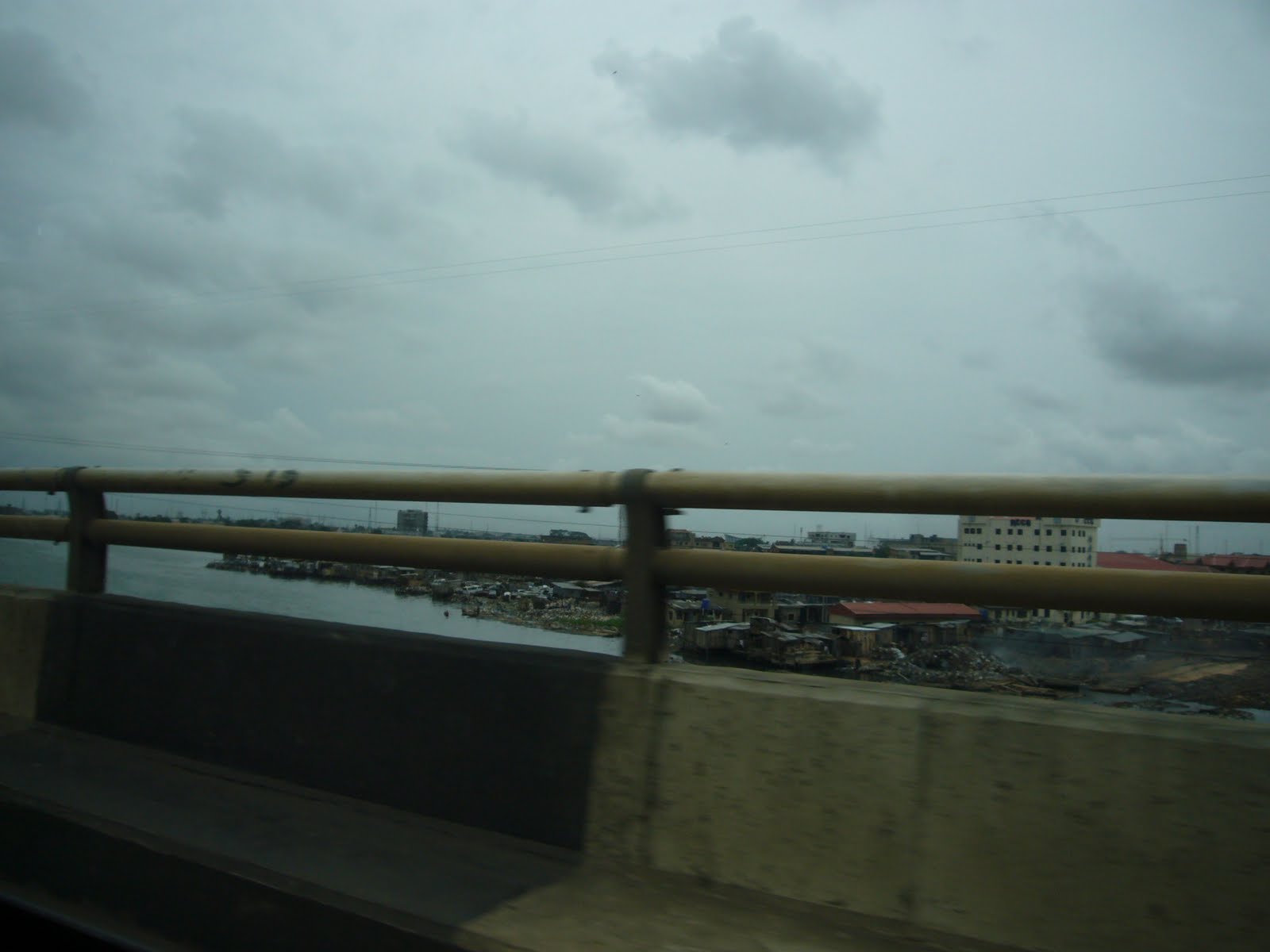
 The room is smaller but more updated. It has been sufficient and pretty comfortable. The lighting is dim (it was so bright at the other place) and there is some silly air freshener that sprays some cocoa butter scent every 20 minutes or so. I wish I could disable that. There is also free wifi plus a work out room that I might check out later this week to get back with the program (I haven't formally exercised in 3+ wks).Dr. Bode generously took time out of his schedule to give us a very informative and enthusiastic driving tour of Lagos. He seemed to know what every building was and knew he way around quite well, directing our driver where to go. The local roads were pretty well paved (unlike Ibadan in general) and traffic was light (because it wasn't a regular work day). There are both large government buses (like the ones in the US) and lots of commerical/private bus drivers and taxis. Okadas (motorcycle taxis) are illegal in Lagos whereas prevalent in Ibadan. Many more people were wearing helmets on their motorbikes unlike Ibadan where only a few wore helmets.Here's a picture of the houses/slums on stilts (poor quality because we were driving across the 3rd mainland bridge, the longest bridge in Africa!). Lagos is part marsh and people live on the water.

 Here is the tallest concrete building in West Africa, the NECOM House.
 The Cathedral Church of Christ, founded in 1867, near the marina.
 A public beach of the Atlantic Ocean. We got accosted by random men to buy a variety of things and to ride a horse. Very aggressive and followed us around. The private beaches are chiller and require payment to enjoy. I was told not to sit down at any of the beach seats. Plus, we had a pay someone to "park" even though I think parking is free. I learned this is to avoid having them deface your car.Here is the ocean at high tide.
 Here is me.
 Next, we went to a shopping mall on Victoria Island, a ritzy part of town. Traffic of course was terrible though the cars were much more fancy - BMWs, Mercedes, Land Rovers and the like. Just because you have a nice car doesn't mean you actually follow road rules.
 This mall was like going to any mall I've been to in the developed world. Air conditioned. Lots of oyibos. There was a Sony store. Fried chicken. Clothing shops. A huge westernized supermarket called Shoprite.
 Here is a map of the shopping complex.
 I can tell that there is a lot of wealth in Lagos. Things are very costly and expensive here. For example, dinner (rice and fish) cost over $17 USD! Even the local Nigerian food costs more. On the flip side, the beggars and poor are still very poor and very aggressive. I think one young man spent about 5 minutes begging to me outside the car at a stoplight saying he was begging because of the grace of God. This is why Dr. Bode told me and the driver to lock the door the second we got into the car.Despite the wealth and relatively more order and drivable roads in Nigeria, here are some signs to enjoy.Don't urinate or dump waste here.
 Don't urinate here as well if you can zoom in.
 Don't think this house is for sale, beware of 419 scam that originated from Nigeria.
 I saw a sign that said street hawking was prohibited and that it would be enforced by the police. Of course, there were street hawkers within 10 feet of the sign. Missed photograph opportunity!I went to a local clothing market near the marina. I was able to haggle for some Nigerian made shirts for family. I tried to buy a premade dress for me or my mom or mother in law but literally the dresses looked like they could fit 2 of me. Too big!
 I didn't end up going clubbing at night and fell asleep. Earlier, Dr. Sola tried to convince me to go as he told me a story about how a couple of years ago, his family was all in Nigeria visiting. His children, in their 20s, when out with their cousins and Dr. Sola and his wife went out with their friends. His children at gotten home at about 3 AM but couldn't get into the house because the parents had the house key and were out until 5 AM. As I said, Nigerians know how to party!At night, I watched some CNN and the coverage on Nigerian election violence was pretty distorting. The violence has been isolated to the conflicted northern part. The southwest part of Nigeria where Lagos and Ibadan are has been quite peaceful. Even the US State Department issued a travel warning on April 15. Don't worry, I'm quite safe and I'm not one to wandering around alone or at night. We will be having 10 PM curfew on Monday night for the Tuesday governor elections with no movement between 8 AM and 4/5 PM. The governor elections in 2 conflicted northern Nigerian states has been postponed.Tomorrow, more exploring and shopping (of course)!
Hello from Lagos! Day 22, we left Ibadan to Lagos for a fairly uneventful drive. Here are some pictures from our drive out of Ibadan - a better picture of the red roofs. I'm always amazed how men and women carry stuff on their heads. Women seem to be able to hold more impressive items more effortlessly.
 I was in good company during the drive with several professors from where I work in Chicago and we had quite an animated conversation about the proposed changes in medical education after they had met with administration of UI. The professors' observations where quite in line with my own and the leadership at UI acknowledged many deficiencies and needs for improvement include quality assurance, supervision of teaching residents, accountability of faculty to give lectures (some weren't showing up), continuing medical education for attendings, resident evaluations of faculty and the faults of a broken consumer payer based health care system to undergraduate and graduate medical education. We all had dramatic examples of the above but I felt happy to hear that the leadership was receptive and proactively working on change.Another thing I learned was that 40-60% of admissions at UCH were due to stroke which is very much contributed by uncontrolled and/or undiagnosed high blood pressure. To get on my preventive soap box for a second, high blood pressure doesn't have any "symptoms" until something really bad happens (stroke, heart attack, heart failure, kidney failure, vision loss) but is a very easy problem to diagnosis and treat quite affordably. What it sounds like is that Ibadan needs a good community outreach program possibly within their churches and mosques (since many attend services very regularly) to screen for high blood pressure (no expense there except to borrow a blood pressure cuff and recruit trained volunteers). Certainly, diagnosing high blood pressure and then providing even a little treatment with very cheap medications would stand to improve the health and reduce the costs and burdens resulting from longstanding, uncontrolled high blood pressure. (Off soap box now)Before the professors headed to the airport for their flight wearing their new Nigerian attire that was made for them (they were measured for clothing on their first day like I was!), we stopped by the Lagos State University Teaching Hospital (LASUTH), a state government supported hospital that provides, get this, free health care for those 0-12 years old and those 60+ years old! (UCH is a federal government hospital; states run independently similarly as states in the US do). We toured their new technology and lab area which was seriously state of the art. It was built within the last 2 years - clean and spacious with up to date technology and equipment to do lab/chemistry/micro examinations and MRI/CT scans. It was nicer than the hospital where I work at in Chicago! Dr. Sola had wanted us to see the spectrum of health care delivery in Nigeria that is clearly affected by how money is spent by the leadership. I have to say I am quite impressed by the LASUTH and Lagos State government for pulling this off. I almost thought I was in another country given what I had been seeing at UCH for the last 3 weeks. Plus, I learned that the Lagos State governor, in an effort to combat wide spread driving on the wrong side of the road, enacted a law such that if anyone was caught doing this, they would be arrested, taken to a hospital for a psych examination that could take up to 5 days to happen (as what sane person would drive on the wrong side of the road? (answer = Nigerians) and pay a fine. Many props (and laughs) to the governor!We also toured a medical student hostel which was quite clean and spacious and new on the LASUTH campus. Each student had their own room and there were shared bathroom, kitchen and laundry (no machine, but large buckets) facilities. Water from the tap. Quite modern, well ventilated and maintained. In the future, they hope to have visiting residents and students like myself stay in the hostel. However, as my experience at LASUTH was arranged at the last minute, I will be staying in a hotel for the duration of my stay in Lagos with a driver (yes, I know, a driver!). I also learned that LASUTH had been off strike for the last 4 wks or so... oh well, at least I have the chance to see how things run here.As I discovered, there wasn't a distinct plan of where I (and Nathan the med student who was joining along for the wknd) would be staying and since I would need to pay for 8 nights of hotel (which would be mostly reimbursed with the institutional funding I had received), I wanted to be cost conscious. I wanted to stay somewhere mid-priced, safe, clean and preferably with a generator (I don't like sitting in the sweltering heat in the dark).We looked at a few places at about 6000 to 10000 Naira a night ($38-64 USD/night) which I can describe as slightly ghetto (one hotel didn't turn on their gent until 6 PM if the power went out during the day) and pretty dingy. Plus, I just didn't get a good sense of the surroundings despite all of them having a security guard at the gate. We ended up at the Lagos Travel Inn which was like a Holiday Inn/Days Inn level. They had a gent; it appeared clean; free breakfast and wifi on the weekends. Not bad, eh at 17500 Naira/night ($113 USD). Plus it had a TV! Later on, at the suggestion of Sope, we checked out White House, another hotel that was close by in a wealthy neigborhood. It was newer and with a pool and exercise facilities for only 15000 Naira/night ($97 USD) despite the advertised rate being over 30000 Naira/night. We mentioned that someone had told us of the about $100 USD per night and we got it. I think there was some Nigerian connection on the downlow that got us this rate. All in all, we must have spent at least 2 hrs hotel shopping. In the end, one night was to be spent at the Lagos Travel Inn (since we paid for it already) and then we would move to the White House. Our hosts from LASUTH were very kind to cover the hotel and meal expenses for our first two days. How generous the Yoruba are.Here is my room at the Lagos Travel Inn.
Later that night, we joined Dr. Bode, a medical director at LASUTH, at the Lagos Country Club where he is a lifetime member. I've never been to any country club anywhere so I didn't know what to expect. I have to say the Lagos Country Club is pretty posh with a biometric ID element (you have to scan your finger) and key card scan to just get in. Since Lagos power is worse than Ibadan power, this country club has enough generators to supply electricity to this multi-building country club outfitted with multiple bars, a cooling room (24 hrs air conditioning), badminton, swimming pool, restaurant, ping pong, LCD TVs, basketball court, reception facilities, bowel, cricket, taikwando and lots of other stuff I'm probably missing.From what I learned, there is a pretty extensive process to join where you need to be referred; there is a three month period where ppl can oppose your attempt to join; if you get through that part, you have to pay a $3000 USD membership fee with probably somewhat regular dues. Once a member dies, their children can continue with the membership. Clearly, only the rich can participate. Dr. Bode frequents the country club a lot as he is a avid ping pong player and from what I can gather, Nigerians love to socialize, dance and gab. Each area (i.e. tennis, ping pong, cricket) have a chairman which their pictures placed in a glass cases (Nigerians also like their glory like Asians). Children are seen running about. The club seemed family oriented but also a way for adult men and women to hang out to a late hour.Dr. Atendule (I'm butchering the spelling (and pronunciation)) who is a dental surgeon and works with Dr. Bode (and assisted us with our hotel shopping) took us to eat at the club's restaurant. I got some Chinese stir fry noodles and curry chicken on rice. Much better than the Chinese food I had in Ibadan though this might have been influenced by hunger as I hadn't eaten since breakfast and it was now 6 PM. Pretty affordable by Lagos standards. He also ordered us a Chapman, a non-alcoholic beverage with a type of bitter, which contained ice. I was hesitant to drink this because I was told by several sources to not ingest ice in Africa but I really didn't want to be rude and it tasted quite nice. I was relieved to later find out that the ice at the country club was made from bottled water. Of course, I'm at a country club!Dr. Bode, while we were hanging out in the country club, conveyed his love of Nigeria and his wishes to stay in Nigeria. Though he has traveled quite a bit and his children are studying abroad in the US and UK, it's the expectation that he and they will all return to Nigeria. He loves his life in Nigeria and doesn't feel that he can get all the personal and social amenities elsewhere, even Houston which apparently has a huge Nigerian community. We talked about power and water and how Nigerians provide this for themselves (if they are financially able to do so) since the government can't seem to get it together yet to do so. My favorite statement from him was that in response to bad roads, you should just get a SUV! No wonder I've seen many Rav4s, Pathfinders, and Land Rovers in Lagos already. My first impressions of Lagos is that there is the wealthy and they live well. There is also the poor, many of whom I learned are Hausa, an ethnic group from Northern Nigeria. The beggers in Lagos are much more aggressive and persistent (this is why I always lock the car door when I get in). The wealthy live well and some have drivers that are employed at about 20000 Naira/month (less than $200 USD) with often room and board. The wealthy are also very generous hosts and want to make sure everyone is as comfortable as possible. I'm quite fortunate to have a driver during my week here, mostly I think for safety reasons but also to facilitate my ability to get around to see the city. (This will NOT be a common occurrence for future students/residents!)Now that I was in Lagos, which Sope is much more familiar with, Sope's friend and nephew both gave me a call with offers to show us around. Cool. Dr. Sola was going to have his daughter's boyfriend who lives in Lagos show us around. Nathan is very excited about clubbing. I (if you know me at all) was most thrilled about shopping and eating; not so much on the clubbing. It was also very sweet for some of the friends I had made in Ibadan to call and make sure I made it safely.Tomorrow, we should start our exploring!

 The room is smaller but more updated. It has been sufficient and pretty comfortable. The lighting is dim (it was so bright at the other place) and there is some silly air freshener that sprays some cocoa butter scent every 20 minutes or so. I wish I could disable that. There is also free wifi plus a work out room that I might check out later this week to get back with the program (I haven't formally exercised in 3+ wks).