Showing posts with label Bumni. Show all posts

Monday, April 18, 2011

Day 17: Driving, Traffic, Security Checkpoints & Dancing

I woke up early on Day 17 as Dayo had said we were leaving at 8 AM for Lagos to attend the church service before the afternoon birthday celebration for Dr. Sola's sister (this is typical of birthday/wedding celebrations). Dr. Sola is one of the Nigerian physicians from the hospital in Chicago where I train that helped arrange this trip. Sope was kind enough to snag an invite for me before I left Chicago.

We left pretty close to 8 AM and Bunmi and Dayo came to pick me up. Bunmi initially drove to drop herself off at church. I make this point because Bunmi is learning how to drive and Dayo, as most driving teachers are, was a bit concerned about how Bunmi was driving. Being a passenger in the car, Bunmi drove very well and safely. I discovered that most of the honking is a courtesy to let others know that you are coming esp around corners with lots of blind spots; sometimes, clearly, the honking is for the get the #*&! out of my way. For other drivers to know that Bunmi is learning how to drive, Dayo placed the letter L in front of their car's license plate; this is common practice. Dayo said this was to alert others to "take it easy" on an inexperienced driver. I asked Dayo when Bunmi was going to take her driving test and he sort of laughed - what driving test? Apparently, you only need to get a driving “license” once you get a car for a fee but there is no required or offered driving test. This explains a lot.

Here is the L to designate driver learning how to drive.

Our drive there was pretty uneventful and traffic was light as most Nigerians are in church on Sundays. We listened to hip hop and Yoruba gospel music on the way. As I had described before - the hawkers, ppl running across the high ways, weaving, and massive potholes - held true but our drive only took about 1.5 hours. This was amazing considering the 3+ hours when we had driven from Lagos to Ibadan when I first arrived. On the way back, we weren’t so fortunate and got caught in a bit of traffic and got pulled over once where Dayo was threatened by a police officer at a security checkpoint for a bribe. Still no bribes given. The police officer even asked me if I knew Dayo and was okay; what I wanted to say to the police officer was that I would be okay if he would just let us go! I’m beginning to find the police and their blatant asking for bribes a bit annoying.

Here is one traffic incident that we encountered on the way home. Keep in mind, we are driving on the appropriate side of the highway.

The first thing that came to mind to Dayo was – was this robbers versus a traffic accident? Dayo yelled out to another driver (that yes, was driving on the wrong side of the road) and the driver confirmed an accident. After battling it out with the vehicles driving on the wrong side of road, we did discover a large semi hauling materials had turned over on the other side of the highway and cars started passing the medium to bypass this accident. Not too much later, we saw another accident with 3 large trucks/semis, this time on our side of the road. No wonder road traffic accidents are a major source of morbidity and mortality in Nigeria.

Back to the party - I was all gussied up for today’s event. I wore my short African print dress with a cardigan. Bunmi fixed up my gele. I even wore pantyhose (to deflect those pesky mosquitoes) and heels. The heels proved to be short lived as within 10 seconds of stepping out of the car to walk to the church, I tripped and fell. I skinned my right knee which I haven’t done since I was like 6 years old. I changed my shoes to flats which I had brought with me I guess anticipating something like this or just painful feet from wearing heels. I’m not sure anyone except Dayo (who saw me fell) noticed my skinned knee and run in my pantyhose all day (as based on my insect bites on the face, people seem to bring up these type of things). Perhaps they were all curiously interested in seeing how the oyibo wore a gele!

This Yoruba Christian church service was spirited with lots of dancing (we formed a dancing line behind the birthday celebrant), singing, and of course praying. Since my arrival in Nigeria, I have noticed that Nigerians in general are very observant to their religion, either Christianity or Islam. In fact, almost all friends I’ve made have inquired about my religious preferences and most Christians have invited me to their Sunday church service or weekly bible study. As not a Christian, I felt this church service to be quite inviting and not intimidating at all.

We had arrived a bit late and joined in as the minister gave his sermon. About midway through, the church transitioned into a focused prayer for the birthday celebrant celebrating her 60th birthday. There is an introduction of the birthday celebrant and her friends and family form a dancing line behind her to the beat of a lively Yoruba Christian song. There are specific prayers esp for the celebrant and the celebrant said her own prayer as well. I was hesitant to join the dancing line behind the birthday celebrant but another churchgoer and attendee to the birthday party tapped my arm to have me join in.

One thing that was quite striking was that the churchgoers were in a variety of dress – some traditional Nigerian dresses with gele (both men and women) and some in Western dress. The Nigerian dresses were very colorful with many women wearing fushia gele which I learned was one of the official colors of the birthday party (more on this later). The men dressed in complete Nigerian attire looked quite grand with their overcoat of sorts (Dr. Sola was wearing one). There was an offering (tithe) part of the service where churchgoers make their rounds up to the front to place them in a basket and the minister also took time to welcome those new to the church, attending for the first time. Dayo stood up to be welcomed; I was shy and didn’t want to attract more attention (as I was the only oyibo) and stayed seated. There was a part of the service where the church’s radio station made announcements and played music. What I thought I heard was good old regular rap was indeed rap but Yoruba Christian rap. Nice.

Following the church service, we went back to the celebrant’s house to relax until the reception started at 1 PM. Of course, while we waited, the power went out. Irony of this was that Dr. Sola and I were talking about how I had taken power for granted beforehand. Dr. Sola’s mother’s home had not had power for 10 straight days and had been living off intermittent gent. Now, as you probably can tell, I am very appreciative of power. We arrived with the celebrant at the reception fashionably late at 1:40 PM and I think the festivities started at 2:30 PM.

Here is the invitation. Note the bottom where they make mention of the official colors: fuchsia and silver. Friends and family purchase cloth in one of the colors or in a certain pattern to be made into a gele (or attire) that is worn to the event in solidarity and support of the celebrant. This is also done for Nigerian weddings as well. Emmanuel was so kind to extend an invitation to his wedding (his colors are brown and pink I believe) but I’ll be leaving the day of his wedding. Too bad I’ll have to miss out on the festivities.

Here is the set up of the reception. Note the decorations in the official colors.

Here’s me!

Here is the official program for the reception. Lots of speeches. Dr. Sola and his daughter Dayo (Dayo is both a woman and man name; apparently, many Nigerian names are unisex.) both gave speeches. Lots of rhythmic musical interludes.

Here is the official menu. Apparently the celebrant is a caterer and her catering company catered the event.

Here is what I had:

Here is a springroll. Tasted like an egg roll.

Goat Meat Pepper Soup. Definitely peppery with a variety of goat parts. All in all, pretty flavorful and tasty. Didn’t eat the part that appeared to be goat liver.

Spicy fish with blackened sauce and fried rice and moin moin which is grounded up beans made into a paste. The fish was a very generous piece and tasty. Not spicy at all. My favorite part was the moin moin. First time I had it and it was good! I could have this again in Chicago. The server told me she wasn’t going to clear away my food until I finished it all.

What I found very cool was that the Olopade family all had their clothes for this event made with a matching print fabric. So Dr. Sola is an Olopade and his daughter, nieces, nephews, brothers and sisters also all Olopades all had matching clothes in different designs and styles. The celebrant’s children all had clothes made of another print. For another celebration, the family might pick another print and have new clothes made.

This makes me very excited to get matching clothing made for Eddy and I as when we next attend a Nigerian party in Chicago (which might be a distinct possibility), we can wear our matching outfits so everyone knows who’s family and who I’m with. I think this reflects how important family and unity is in Nigerian culture. The headwear is in fuchsia in support of the celebrant and the colors she has selected. Just by looking at the colors throughout the room, you can tell who is family. Beautiful.

Here are some Olopades.

Here are some more.

Here is Dr. Sola, Dayo and our driver, Mr. Modi.

We are on the dance floor now. Nigerians of all ages definitely got rhythm. Apparently, the celebrant dances and people place money bills on her face and they collect it in a bag sort of like the Filipino money dance or the Greek tradition of throwing money in the air. Later I learned that this is considered illegal (as a sort of defacing money) but still widely practiced.

What I found out is that if anyone else dances, like me, we might get some money too! Here’s Dr. Sola demonstrating how I might get some money (sorry for the blurriness!).

Here is the personalized swag that we left with. (Dayo mentioned how this was a high end birthday celebration; not all Nigerian birthday celebrations are so extravagant).

All in all, this was a great, fun, cultural experience. I’m appreciative that I was able to attend. What I learned is that Nigerians like to party, are generous and religiously focused in their partying and celebrate their age. Whereas other might want to hide their older age, Nigerians celebrate it!

Happy 60th birthday Mrs. Kikelomo Abiodun Abidoye!

One last picture, Ibadan is known for its red roofs – take a look!

Sunday, April 3, 2011

Day 3: Being an Oyibo, Nigerian Elections & Amala

I was hoping to write daily posts every night but however... can you guess? There was no electricity again! Our generator ran out of fuel (I think one of the guards turned the generator on earlier in the day and we didn't realize it b/c the generator needs to be turned off once the central electricity is on to conserve fuel but there is no way to know except to look at the generator). So last night, I had running water and was able to bathe with a shower.... to the illumination of a flashlight. Good times!

I was ready to eat some Nigerian food and we ended getting some amala with obe (soup) with efo (vegetables) and chicken. Very traditional West African food. The amala had a nice texture which is kind of pasty/starchy which I enjoyed and I thought the soup was nicely spiced. You are suppose to take a piece of the amala with your hands and dip it in the soup. Dayo ate with hands and I ate with a fork. This was in part because we brought the food to the guesthouse to enjoy and discovered more cockroaches (one of them crawling next to my laptop in the dining room... you better know that I disinfected my laptop!) in the dining room. Bunmi was pretty adept at killing them with her shoe. I of course was useless and squealing and therefore ate food with a fork. This is when we also realized that the generator was out of fuel and we ate using light from the flashlights.


While we waited for the food to be the ready, Dayo, Bunmi and I talked about life in Nigeria. I expressed my stress and discomfort with the unpredictability of having electricity and running water. We discussed the sad cases of patients who could not receive care because of intense poverty as Bunmi is an ENT ward nurse at University College Hospital (UCH) Ibadan. She talked about how she would use a manual suction in the dark to suction out her patients during power outages. We also discussed how Nigeria was so rich in oil (resulting in much of the fighting and violence again foreigners related to the oil trade in the Niger-Delta region up north) and yet most of its people up to 60-75% live in poverty and where I've seen quoted, on less than $1 USD a day.


Having electricity and running water is something that I've taken for granted every day and if there was no electricity or running water, there was a clear reason and I would wait knowing that something was happening to get it resolved as soon as possible. However, there just seems to be no rhyme or no reason why the electricity goes out or why we don't have any water. If you are living already in poverty and now you need to worry about how to cook food for your family or how to have water to bathe and drink as well that is already a lot of spent energy and thought.


This now brings me to the all important Nigerian elections for state assembly, governor and president that will be happening 3 consecutive Saturdays in April. Each Saturday, starting this coming Saturday, April 9, there will be a curfew that is imposed between 8 am to 4 pm. People are only allowed out of their home to vote during that period and otherwise should be at home. This is because of the election related violence that has been happening, has happened in the past and is anticipated to occur. It seems like the violence is related between members of different parties killing each and assassinating politicians. Being an elected official is quite a coveted job as it pays extremely well including perks valued at up to $1 million a year. Crazy.


In part, because of this, Nigerian government has been viewed to be corrupted, self-oriented and ineffectual in implementing nation wide changes to improve health, clean drinkable water and electricity among other things. In fact, I was told that the Chinese mafia in Nigeria (who are quite the entrepreneurs) run an very lucrative business of importing and selling generators that almost every household has with such spotty electricity. Perhaps the power outages are in part driven by this profit margin?


In any case, these upcoming elections are very important in electing officials that will advocate and work for positive change. The elections were to start this last Saturday but had to be delayed because ballots were not received in time to be distributed throughout Nigeria before the voting was to start. Then, it was suppose to happen on the Monday but ultimately rescheduled to start this Saturday. From all the locals I've spoken too about this, they hope for a clean and fair election as prior ones had been marred by tainted votes, ballot stuffing and the like. From what I've told, the violence is very directed to specific people and specific locations that does not reach the UCH complex (thank goodness!). You can be sure I'm staying indoors!


This now brings me to discussing being an
oyibo. Literally, in Yoruba, oyibo means white man but over the years has evolved to mean foriegner with any skin color other than black. Of course, I find lots of humor in this because well I have never considered myself white! Growing up, I was always 1 of a handful of minorities in the schools I attended in the suburbs of Chicago. In fact, I knew I wasn't white esp when my white classmates and strangers would make a point to say things about my squinty, slanty eyes. Thus, to be considered white and what that means historically in Africa and the US, is kind of amusing. Everywhere I go, everyone looks at me as it appears I'm the only oyibo that is around the hospital complex. Children look at me with wonder as previously the only oyibos they have seen might be on TV. Men and women squeal "oyibo!" when they see me. I've been told to take this as a term of endearment. Quite frankly, it just makes me feel much more self conscious. Where I work in Chicago, most of my patients are African American and while I know that I'm Asian and they are African American, it's not something I think about. Here, being pointed out, albeit in mostly a friendly manner, draws some unwanted attention. I suppose I'll get use to it.

Here's Dayo and Bunmi


I suppose relatively speaking... I look white....

Saturday, April 2, 2011

Day 1 : Guesthouse & Dayo

I need to catch on posts since today is already Day 2 so for Day 1:

Here's guesthouse from the side. The physicians from UofC that set up this experience are Nigerians and run a NGO in Nigeria called
Healthy Life for All Foundation that is based out of this guesthouse. On the first floor, there are offices, a dining room/parlor, a kitchen (with lots of cockroaches eek!) and 2 half baths. The second floor has 3 bedrooms and there are 2 full bathrooms and a room with just a toilet. This guesthouse is on site in the University College Hospital in Ibadan complex with security to enter to complex and an almost 24 hour security guard seated outside this guesthouse. I don't think this is an indirect reflection of safety at the guesthouse...

Here's a walking tour when you walk inThe dining room/parlor. Nice area with air conditioning and lots of room.
The infamous kitchen with cockroaches. I first saw one and yelped. Dayo sprayed insecticide. We walked away, I checked again, 2 more cockroaches. More spraying and we opened all the cabinets. 20 minutes later, I check again - 5 COCKROACHES! More spraying. Dayo would tell me each time that they were all dead and gone and every time I would check, there would be more! This was definitely a source of laughter for us. On a practical note, Dayo did fleet the kitchen and someone will be more thoroughly clean the kitchen on Monday. Until then, I only go into the kitchen to get something from the fridge. 10 cockroaches and counting. If you look closely, you might be able to see one in the picture.

My room (after I've lived in it a couple of days - forgot to take a picture when it I walked in). Nigerian beds are hard and the pillow is a bit hard. I have blankets b/c I'm fortunate to have an in room air conditioner!

Another view of the room walking out. I have a little sink. Little bugs like to roam around this sink. A built-in area for clothes.


The bathroom. A toilet. A shower. A sink. Occasional running water.

Events & Observations on Day 1:
* Woke up in a sweat at 6 AM and discovered that the power went out and the AC shut off. Apparently, this is a common occurrence about 2-5x/day. But I'm prepared - I have a flashlight but I'm sweating buckets.
* Running water is an issue. We have a water reservoir and from that water reservoir, water has to be pumped to another reservoir to provide running water in our bathrooms. I thought I had broke the toilet b/c it didn't flush but in actuality - there was no more water in the reservoir!
* Dayo and his wife Bumni brought me around town to get food supplies. We must have gone to at least 5 different places to get a phone card, bread, peanut butter, pasta, tomato sauce (I was so happy to buy my $7 USD Classico pasta sauce!), fruit that I will peel, bottled Eva water by the Coke company, eggs, oil, hangers, 6 plates and bowls made in China for $7 USD. Cheaper prices at different locations. Makes sense to me.
* It's hard to bargain here. I couldn't bargain the price down for plates, bowls and hangers but they were still pretty affordable. One thing I did bargained somewhat successfully was for my USD to Naira conversion rate. Word of advice, bring $100 or $50s as the exchange rate for that denomination is higher than the exchange rate for $20s. You ask why I bargained for my conversion rate? Nigerians don't convert money in banks. We converted in some person's office/home and negotiated our rate. Apparently, there is a certain road where all the money converters have offices/homes.
* I got 6 yards of fabric made in Ghana to be made into 2 Nigerian dresses for a birthday party I'm attending mid-month. Couture too - as I got measured for the dresses and they will be made to fit. $2200 Naira for the fabric and $5000 Naira for the tailoring = 2 dresses for about $46 USD! Bumni, Dayo's wife, negotiated the price of the tailor from $6400 to $5000 Naira - I was pretty impressed. The tailor and his young assistants squealed "Oyibo" when they saw me... more on this later.

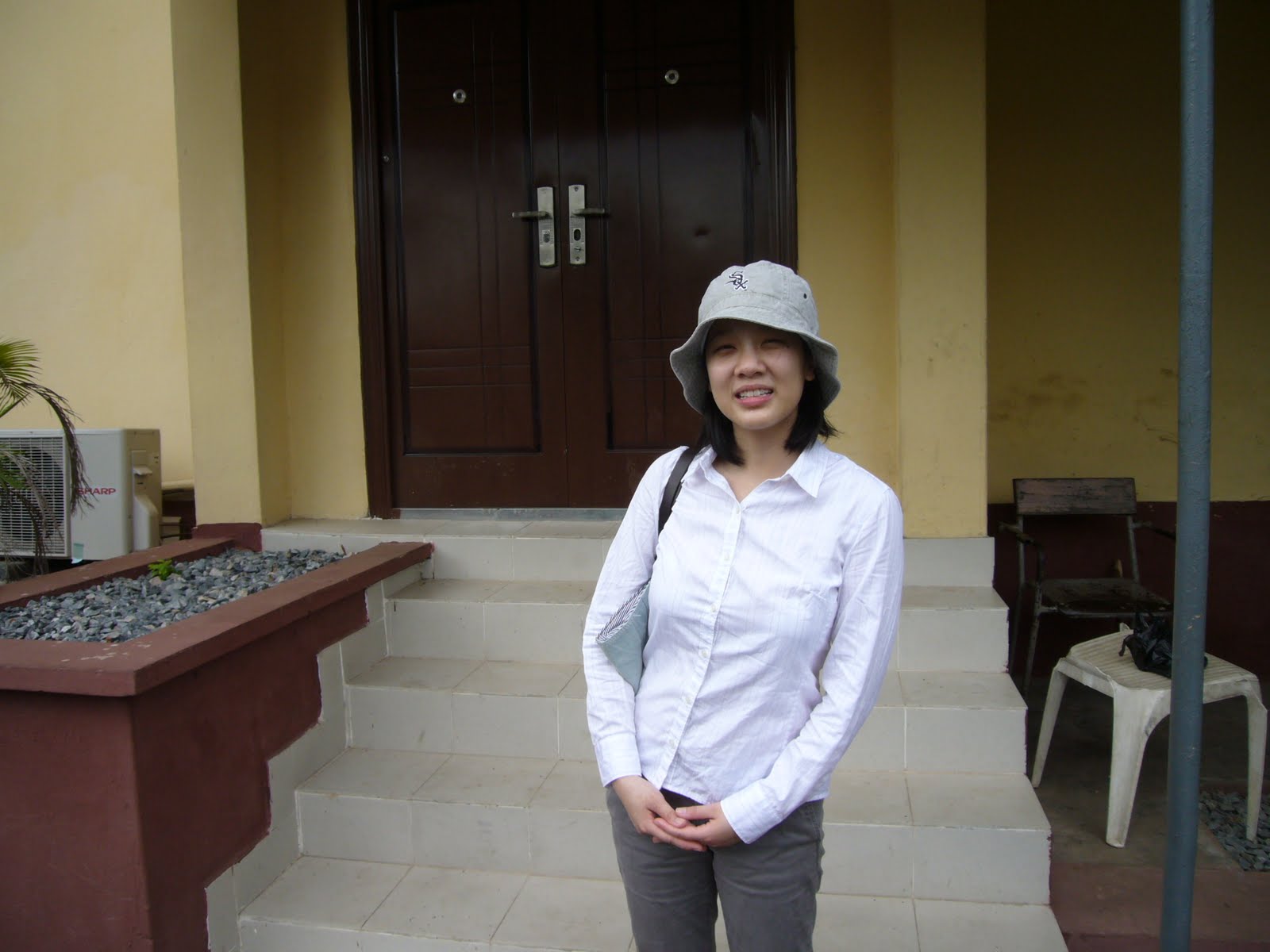
Here's a picture of me in front of the house and here's a picture of Dayo. He's helping me make my transition much smoother and comfortable as possible. How old do you think he is?