Showing posts with label Dayo. Show all posts

Monday, April 18, 2011

Day 17: Driving, Traffic, Security Checkpoints & Dancing

I woke up early on Day 17 as Dayo had said we were leaving at 8 AM for Lagos to attend the church service before the afternoon birthday celebration for Dr. Sola's sister (this is typical of birthday/wedding celebrations). Dr. Sola is one of the Nigerian physicians from the hospital in Chicago where I train that helped arrange this trip. Sope was kind enough to snag an invite for me before I left Chicago.

We left pretty close to 8 AM and Bunmi and Dayo came to pick me up. Bunmi initially drove to drop herself off at church. I make this point because Bunmi is learning how to drive and Dayo, as most driving teachers are, was a bit concerned about how Bunmi was driving. Being a passenger in the car, Bunmi drove very well and safely. I discovered that most of the honking is a courtesy to let others know that you are coming esp around corners with lots of blind spots; sometimes, clearly, the honking is for the get the #*&! out of my way. For other drivers to know that Bunmi is learning how to drive, Dayo placed the letter L in front of their car's license plate; this is common practice. Dayo said this was to alert others to "take it easy" on an inexperienced driver. I asked Dayo when Bunmi was going to take her driving test and he sort of laughed - what driving test? Apparently, you only need to get a driving “license” once you get a car for a fee but there is no required or offered driving test. This explains a lot.

Here is the L to designate driver learning how to drive.

Our drive there was pretty uneventful and traffic was light as most Nigerians are in church on Sundays. We listened to hip hop and Yoruba gospel music on the way. As I had described before - the hawkers, ppl running across the high ways, weaving, and massive potholes - held true but our drive only took about 1.5 hours. This was amazing considering the 3+ hours when we had driven from Lagos to Ibadan when I first arrived. On the way back, we weren’t so fortunate and got caught in a bit of traffic and got pulled over once where Dayo was threatened by a police officer at a security checkpoint for a bribe. Still no bribes given. The police officer even asked me if I knew Dayo and was okay; what I wanted to say to the police officer was that I would be okay if he would just let us go! I’m beginning to find the police and their blatant asking for bribes a bit annoying.

Here is one traffic incident that we encountered on the way home. Keep in mind, we are driving on the appropriate side of the highway.

The first thing that came to mind to Dayo was – was this robbers versus a traffic accident? Dayo yelled out to another driver (that yes, was driving on the wrong side of the road) and the driver confirmed an accident. After battling it out with the vehicles driving on the wrong side of road, we did discover a large semi hauling materials had turned over on the other side of the highway and cars started passing the medium to bypass this accident. Not too much later, we saw another accident with 3 large trucks/semis, this time on our side of the road. No wonder road traffic accidents are a major source of morbidity and mortality in Nigeria.

Back to the party - I was all gussied up for today’s event. I wore my short African print dress with a cardigan. Bunmi fixed up my gele. I even wore pantyhose (to deflect those pesky mosquitoes) and heels. The heels proved to be short lived as within 10 seconds of stepping out of the car to walk to the church, I tripped and fell. I skinned my right knee which I haven’t done since I was like 6 years old. I changed my shoes to flats which I had brought with me I guess anticipating something like this or just painful feet from wearing heels. I’m not sure anyone except Dayo (who saw me fell) noticed my skinned knee and run in my pantyhose all day (as based on my insect bites on the face, people seem to bring up these type of things). Perhaps they were all curiously interested in seeing how the oyibo wore a gele!

This Yoruba Christian church service was spirited with lots of dancing (we formed a dancing line behind the birthday celebrant), singing, and of course praying. Since my arrival in Nigeria, I have noticed that Nigerians in general are very observant to their religion, either Christianity or Islam. In fact, almost all friends I’ve made have inquired about my religious preferences and most Christians have invited me to their Sunday church service or weekly bible study. As not a Christian, I felt this church service to be quite inviting and not intimidating at all.

We had arrived a bit late and joined in as the minister gave his sermon. About midway through, the church transitioned into a focused prayer for the birthday celebrant celebrating her 60th birthday. There is an introduction of the birthday celebrant and her friends and family form a dancing line behind her to the beat of a lively Yoruba Christian song. There are specific prayers esp for the celebrant and the celebrant said her own prayer as well. I was hesitant to join the dancing line behind the birthday celebrant but another churchgoer and attendee to the birthday party tapped my arm to have me join in.

One thing that was quite striking was that the churchgoers were in a variety of dress – some traditional Nigerian dresses with gele (both men and women) and some in Western dress. The Nigerian dresses were very colorful with many women wearing fushia gele which I learned was one of the official colors of the birthday party (more on this later). The men dressed in complete Nigerian attire looked quite grand with their overcoat of sorts (Dr. Sola was wearing one). There was an offering (tithe) part of the service where churchgoers make their rounds up to the front to place them in a basket and the minister also took time to welcome those new to the church, attending for the first time. Dayo stood up to be welcomed; I was shy and didn’t want to attract more attention (as I was the only oyibo) and stayed seated. There was a part of the service where the church’s radio station made announcements and played music. What I thought I heard was good old regular rap was indeed rap but Yoruba Christian rap. Nice.

Following the church service, we went back to the celebrant’s house to relax until the reception started at 1 PM. Of course, while we waited, the power went out. Irony of this was that Dr. Sola and I were talking about how I had taken power for granted beforehand. Dr. Sola’s mother’s home had not had power for 10 straight days and had been living off intermittent gent. Now, as you probably can tell, I am very appreciative of power. We arrived with the celebrant at the reception fashionably late at 1:40 PM and I think the festivities started at 2:30 PM.

Here is the invitation. Note the bottom where they make mention of the official colors: fuchsia and silver. Friends and family purchase cloth in one of the colors or in a certain pattern to be made into a gele (or attire) that is worn to the event in solidarity and support of the celebrant. This is also done for Nigerian weddings as well. Emmanuel was so kind to extend an invitation to his wedding (his colors are brown and pink I believe) but I’ll be leaving the day of his wedding. Too bad I’ll have to miss out on the festivities.

Here is the set up of the reception. Note the decorations in the official colors.

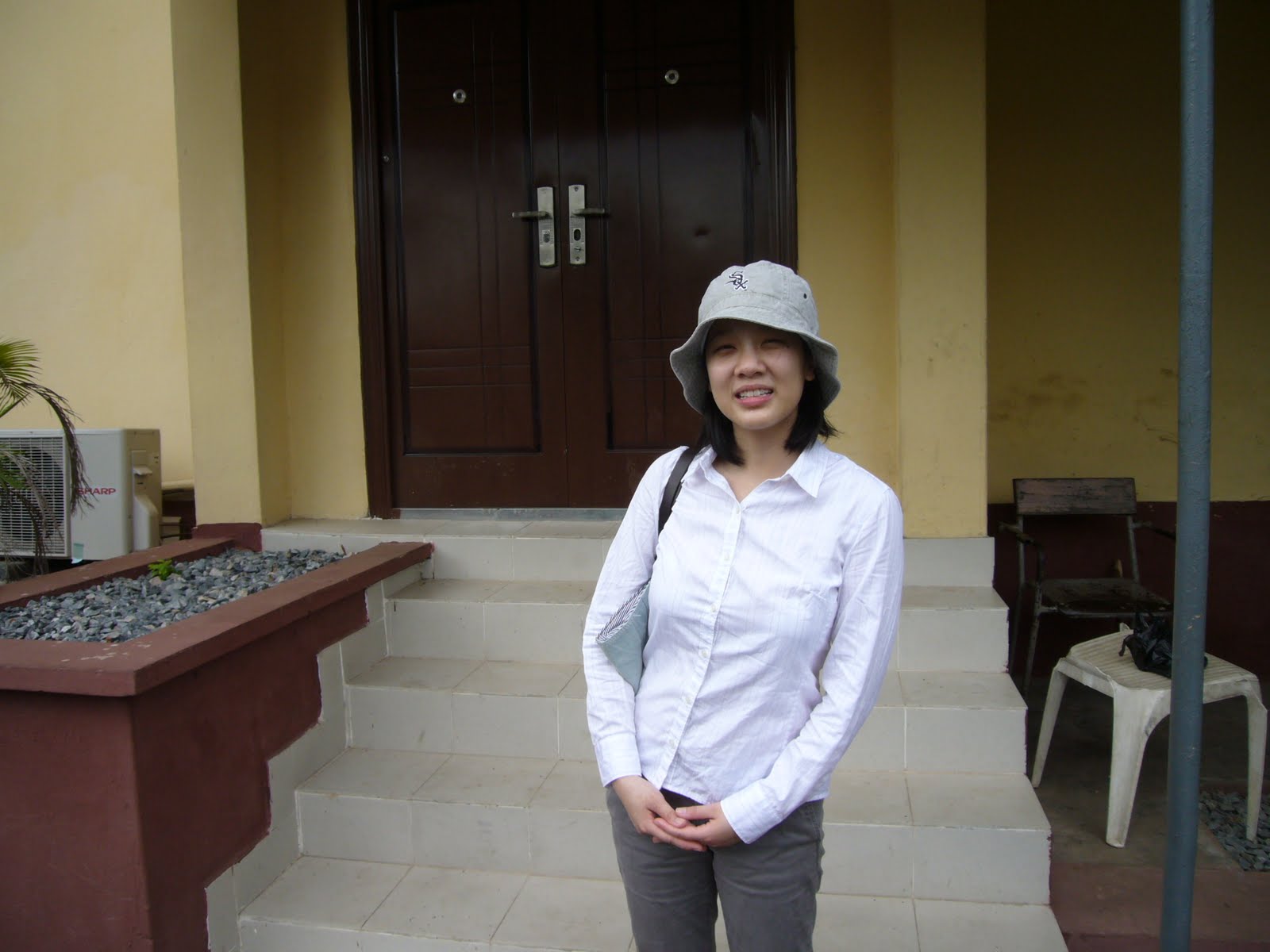
Here’s me!

Here is the official program for the reception. Lots of speeches. Dr. Sola and his daughter Dayo (Dayo is both a woman and man name; apparently, many Nigerian names are unisex.) both gave speeches. Lots of rhythmic musical interludes.

Here is the official menu. Apparently the celebrant is a caterer and her catering company catered the event.

Here is what I had:

Here is a springroll. Tasted like an egg roll.

Goat Meat Pepper Soup. Definitely peppery with a variety of goat parts. All in all, pretty flavorful and tasty. Didn’t eat the part that appeared to be goat liver.

Spicy fish with blackened sauce and fried rice and moin moin which is grounded up beans made into a paste. The fish was a very generous piece and tasty. Not spicy at all. My favorite part was the moin moin. First time I had it and it was good! I could have this again in Chicago. The server told me she wasn’t going to clear away my food until I finished it all.

What I found very cool was that the Olopade family all had their clothes for this event made with a matching print fabric. So Dr. Sola is an Olopade and his daughter, nieces, nephews, brothers and sisters also all Olopades all had matching clothes in different designs and styles. The celebrant’s children all had clothes made of another print. For another celebration, the family might pick another print and have new clothes made.

This makes me very excited to get matching clothing made for Eddy and I as when we next attend a Nigerian party in Chicago (which might be a distinct possibility), we can wear our matching outfits so everyone knows who’s family and who I’m with. I think this reflects how important family and unity is in Nigerian culture. The headwear is in fuchsia in support of the celebrant and the colors she has selected. Just by looking at the colors throughout the room, you can tell who is family. Beautiful.

Here are some Olopades.

Here are some more.

Here is Dr. Sola, Dayo and our driver, Mr. Modi.

We are on the dance floor now. Nigerians of all ages definitely got rhythm. Apparently, the celebrant dances and people place money bills on her face and they collect it in a bag sort of like the Filipino money dance or the Greek tradition of throwing money in the air. Later I learned that this is considered illegal (as a sort of defacing money) but still widely practiced.

What I found out is that if anyone else dances, like me, we might get some money too! Here’s Dr. Sola demonstrating how I might get some money (sorry for the blurriness!).

Here is the personalized swag that we left with. (Dayo mentioned how this was a high end birthday celebration; not all Nigerian birthday celebrations are so extravagant).

All in all, this was a great, fun, cultural experience. I’m appreciative that I was able to attend. What I learned is that Nigerians like to party, are generous and religiously focused in their partying and celebrate their age. Whereas other might want to hide their older age, Nigerians celebrate it!

Happy 60th birthday Mrs. Kikelomo Abiodun Abidoye!

One last picture, Ibadan is known for its red roofs – take a look!

Thursday, April 7, 2011

Day 6: Pharma, the Chinese and Customs in Nigeria

My grand plan to blog each night was thwarted by (again) the lack of electricity and our generator acting up. We thought our generator was broken and needed to be serviced but the next morning, it was up and running again. Of course! :)

In any case, on Day 6, I participated in the men's triage hall. In the brief time I was there, I saw several cases of presumed gonorrhea and a couple of cases of psychiatric illness. Most of the patient interviews that day (in fact, most days) are conducted in Yoruba, the native language of the predominant ethnic group in Ibadan; the national language in Nigeria in English as a way to unite the country given so many native regional languages exist. Despite that, the consultants and residents I have worked with have been very good about translating the conversations for me. Plus, just by observing, I've been able to pick up on some things such as family members speaking on behalf of the patient (with the patient just sitting there), which in a couple of cases was related to the patient suffering from a psychiatric illness. One other observation - I knew before coming to Nigeria that there was more liberal use of anti-infectives (antibiotics, antimalarials, antifungals) and I certainly have seen that. Lots of pencillins and antimalarials to go around!

From my own practice in clinic in Chicago, I try to take the time to review any imaging (xrays, CT scans) with the patient and to spend a portion of the visit dedicated to explaining why XYZ was happening. Of course, because of all the inefficiencies of things, sometimes this gets placed aside. Since the patients here bring so much of their medical information to each visit (medications (which they call "drugs" here), reports, xrays, family members to corroborate), I have found this perhaps to facilitate a culture and expectation that the physicians spend a good portion of their visits explaining why they have XYZ. As such, patients appeared to be satisfied and empowered in their care. Definitely something I hope to incorporate more when I return to the US.

Later in the day, I learned a little something about "African time". I'm well aware of "Asian time" as my family and I often run on "Asian time" meaning we're late to a lot of things. Plus, working in the Filipino community, I have come to know "Filipino time" too though two of my Filipino American friends who got married last year started their wedding right on time (Eddy and I were 2 minutes late and had to run in before the bride started her processional!). Eddy, on the other hand, doesn't believe in Asian time and has been training me to be more prompt. So yesterday, based on my schedule, I was to participate in afternoon conference/lectures scheduled at 1 PM. I arrived a little early so I could find the location and waited outside the conference room. I waited and waited. And waited. In the end, the lectures started at 2:20 PM with the slow trickle of a critical mass that started about 1:20 PM.

While I was waiting, I met a family medicine senior registrar, Emmanuel, who will be getting married later this month. Our conversation was quite enjoyable and engaging ranging from his upcoming nuptials (his fiancee is a pastor) to palliative care to poverty and health in Nigeria and the US. I appreciated his genuine interest in my perspectives and opinions on Nigeria and he inquired on my thoughts on medicine and life in the US. I hope to run into him again. All in all, I have found that Nigerians are esp welcoming and friendly, taking the time and effort to getting to know you. Often times, they inquire about how I like Nigeria, how I'm adjusting, what I'm eating, if I'm married, if I have children. Perhaps some foreigners may interpret this as a little intrusive but I like it. I feel welcomed. Even walking down the street in the UCH complex or in the hospital itself, strangers will end up greeting me and children will run up to me to say hello.

Having been here for about 1 wk now, I've learned quite a quite about Nigerian and Yoruba culture and customs. Before heading over, I read some websites about expectations such as dressing conservatively, shaking hands to greet, addressing elders by their highest degree (Dr, Professor, etc) and not to use your left hand to accept anything. The dressing conservatively part is easy for me as my fear of malaria lends me to wear pants, socks, clogs and either a long sleeve shirt or layers under my white coat daily (plus DEET lotion too). Shaking hands to greet and doing a modified bowing with a head nod was something I have been accustomed to esp spending time in Taiwan and interacting with elders. It was not an adjustment to use Dr. and Professor as in general life practice, I would err on the side of formality though one noticeable difference is how Nigerians at the same level refer to each other as Dr. The one thing that has been proved to be more challenging is the not to use the left hand to accept things. Do you know how often I use my left hand accept things? Too often! I really need to work on this.

As a pleasant unexpected happening, in the UCH complex, I spoke Chinese! I was on my way to get some Fanta when a middle aged Nigerian man came up to me to ask me if I was Chinese. I replied yes and he responded in excellent Chinese! Whoa... right? The quality and fluency of his Chinese was pretty good and would put some ABCs (American Born Chinese) to shame! He had learned Chinese after living there sometime to do business. He wanted for us to be friends (i.e., he wanted my phone number). In the end, I didn't give him my phone number and he gave me his. Speaking Chinese definitely brought a smile to my face as I encountered something more familiar to me as daily, everything is somewhat unfamiliar and different.

Later in the day, Dayo, as he said, took me to have Chinese food! By Nigerian standards, Chinese food is not inexpensive and there are only 1 or 2 Chinese restaurants in Ibadan. And yes, I did see "my people" there. I saw a couple and their son who presumably run the restaurant. The servers were all Nigerians. I did speak a couple of words to them in Chinese but it didn't go much further than that. This marked the first time I saw a non-African in Nigeria! The is Chinese restaurant was situated in a hotel that was on a hill; before dinner, we took a couple pictures of the view. We even saw another oyibo in the hotel; a true (white man) oyibo.

(I am wearing a lot of clothing to keep the mosquitoes from biting me!)


As to the food, it was okay. We got white sticky rice, stir fry noodles with chicken, Chinese vegetables with Chinese mushrooms and chicken with bamboo shoots (Dayo doesn't eat pork). The most authentic dish had to be the chicken with bamboo shoots and that was the favorite dish for Dayo and I. I want to try dim sum in Lagos as there are more Chinese restaurants there. Nonetheless, it was still nice to eat something a bit more familiar and better yet, I didn't get sick!

Chicken and bamboo shoots

Stir fried noodles with chicken


Chinese veggies with Chinese mushrooms

Before I end, back to the lectures that were suppose to happen. We had a lecture on PTSD (a case of young woman who was abducted and raped by 3 men) and the audience of consultants and residents were very engaged and asked many questions/made comments at the end. I noticed how when they ask questions, they stand and thank the speakers and then ask their question or make a comment. One of the residents facilitated this interaction. We clapped at the end of the presentation too.

Following this lecture, we had a pharmaceutic rep discuss a new malaria agent called Artecxin made of dihydroartemisinin, piperaquine and trimethropim. The key points I extracted from the pharm presentation was that #1 this medication was made in Nigeria (and not China, India or the UK!) #2 that is was affordably priced ($340 Naira for each tab and 8 tabs needed for a course of treatment = 340 Naira x 8 = about $17 USD for a course of treatment) and #3 Nigerian pharma does it like the US pharma - food and beverages and giveaways! Check out the pharma materials that we each received: a nice bag with "roll back malaria", a pen (without any logos), a note pad with pharma marketing and a sample of the medication itself.


Here's a picture of some of the family medicine residents. We sat in the order of rank. The consultants in the very front followed by the senior registrars (senior residents), then the residents, then the house officers and training physicians doing their one year of service to Nigeria.


Other happenings/thoughts/observations:
* I asked a random medical student to direct me to an office. He, of course, helped me and we chatted for a little bit. Later on, he found me at the guesthouse and he'll be organizing an informal get-together with other medical students to dialogue. Sope, see, I'm linking up with students!
* There are few house (intra-hospital) phones. Everyone relies on their cell phone and I have the cell phone number of a couple of head of departments and the chief medical director of UCH. I think when you are on service in the wards, you have a separate cell phone that is passed around. Sometimes, people have more than 1 cell phone for different cell phone providers because cell phone service can be spotty as well.
* On my first day, we tried to buy Diet Coke but the Coke depot (Ibadan has a Coke factory) said they didn't have any. Later on, I discovered that I have to ask for Coca Cola LIGHT, not Diet Coke. On our way to the Chinese restaurant, we picked up a case of Coca Cola Light! Yay!
* Nigerians and the Chinese both talk very loudly, almost angrily, to make a point. At times, I'll see Nigerians raise their voice to make a point (but aren't angry or upset) just like how I raise my voice to make a point when I speak in Mandarin with my parents. Some things are just the same across cultures.

Tuesday, April 5, 2011

Day 5: Medical Education in Nigeria and Agama lizards

I think I'm finally getting into a schedule while I'm here in Ibadan. Last night, the electricity went in and out which didn't phase me that much and water is still flowing and the internet works. It's been a good day! The bug issue is (crossing my fingers) better and I even got a couple of pictures of lizards! The only somewhat unpleasant thing today was that I realized I got a mosquito bite yesterday (...mefloquine... please work! Jane doesn't want malaria!)

Apparently, these lizards are called
agamas. The male ones are colored and the female ones are white/gray. The male ones seem to be easier to photograph (it didn't budge as I moved closer) but the female one that hangs out near our water reservoir always scampers away; this was the best photograph I could take of her (can you see it)! Interesting fact: Males are also known to be polygamous with up to 6 female mates at one time. What a player!

Today, I worked in the women's triage hall staffed by family physicians. I primarily worked with a consultant (attending) physician, Dr.
Adetunji (the same physician I worked with at the HIV/AIDS clinic) and a Nigerian American medical student from George Washington University. The "sorting hall" is a triage where I understand women, men and children are seen in the order of arrival for any type of complaint. Those that need further outpatient evaluation are asked to purchase a card for $2600 Naira to become an established patient in the family medicine outpatient clinic. Those that need referral to a specialty have a referral letter written on the spot and then are sent to the specialty clinic for care. Those that need some basic work up are offered certain tests that may or may not be completed due to cost.

The cases we saw this morning included rectal prolapse with bleeding, fatigue and weakness in a 16 year old, meralgia paresthetica (essentially thigh pain) in a 58 year old grandmother caring for her 9 month old grandchild and corneal abrasion in a physically handicapped Muslim woman. And of course, we also saw lots of high blood pressure as common things are common worldwide. I was impressed by time and effort Dr. Adetunji took to really connect with the psychosocial aspects of these patients life as we discovered that many of their complaints was layered with social, family and cultural challenges and expectations. He also appealed to my preventive side by taking the time to discuss preventive women's health, particularly with the physically handicapped patient as I learned they are traditionally medically neglected in that manner. Plus, he cleaned his hands periodically with a hand sanitizer!

A few observations:


* There is no such thing as patient confidentiality. The consultant and the senior registrar (= senior resident) each see a patient independently in the same room with a medical assistant sitting in between them to log the diagnosis and referrals and process paperwork for payment. While patients are being seen, other patients and family members wander in and out.
* Patients are incredibly patient and understanding. Many times, their brief visit would be interrupted by the above said visitors and they never voiced any complaints.
* Patients bring in all these different color slips of papers with their test results and even their Xrays and all their medications! Talk about being proactive in your care. I wish my patients would bring in their medications instead of telling me to look in the computer.

* No patient charts are pulled for these visits. If the physician thinks the patient needs further outpatient care, they discuss with the patient if they can afford to become an established patient at which point a card (= chart) will be created. For some patients, sometimes multiple patient charts would be created because the original ones could not be found.
* We didn't really have the time or space to exam patients. The closest examination type things we did was to take blood pressure and use an ophthalmoscope to look in someone's eyes.

* All the patients that carried a diagnosis of high blood pressure and were taking medications for it never offered high blood pressure as a medical problem when asked. It was not until we asked them to show us all their drugs that from their purse, they would produce a variety of medications at which point we deduced that they had high blood pressure.

Later in the day, I participated in a family medicine clinic dedicated to dermatology (skin) visits. This involved about 5 patients in the clinic with a large team of housestaff, residents and senior registrars, 2 visiting medical students (one from Washington DC and the other from London, both Nigerian by birth) and the consultant. Thus far, this was probably the most paternalistic teaching I have seen in Nigeria. We sat in a classroom in rows; the patient sat in front of the room; one housestaff/resident would present from the case study (= chart); the consultant sit in front and direct the teaching and patient encounter. The consultant would interject in the presentation every few sentences, critique (and at times criticize) the training physician, at times, in my opinion, speak as if the patient wasn't in the room and have us standing up and down to look at a rash that was essentially acne or dandruff. If the consultant didn't like the way the resident would be addressing the patient or examining the patient, she would swat the resident's hand away. In general, the consultant seemed to be dissatisfied with everyone's performance. If called on, the resident would stand up to answer and if no answer could be provided, the consultant would quickly call on a more senior resident. She also assigned a bunch of random homework assignments.

To be honest, I was really hoping she wouldn't call on me and I tried to participate as much as I felt comfortable with. The consultant and I probably didn't start out the right note because when we were introduced, I extended my hand to shake her hand. She made a point to tell me I was being impolite by Nigerian standards as the elder is suppose to extend their hand first with me then accepting. I promptly apologized blaming my American habits and ignorance.


From my perspective, it's been quite some time that I've been in this sort of environment. I felt that I was in school again and wanted to slouch in my seat so that I wouldn't get called on. Don't get me wrong, I am all for hierarchy in a manner that is most pleasant for all trainees and safe for the patient. However, this hierarchy seems much higher/prominent in Nigerian medicine than what I've been accustomed to training in the US and becoming an attending in a few short months. Plus, one of the patients we were seeing was a 16 year old young woman with hair loss who admittedly had Asian like eyes and the consultant had to make mentioned how this patient's eyes looked like me which I felt had little applicability to the purpose of the clinic.


I discovered that this teaching style is extremely common in Nigerian medical education as the residents shared with me. On the other hand, the visiting medical students shared my sentiments and perspective having been trained in the US and UK. As a contrast, I described how I would see patients in a specialty clinic as a training physician in which, a similar but smaller team would discuss the case, I would present a plan and we would dialogue about the plan in an warm and welcoming environment that was noticeably less paternalism toward the patient and the trainees. This seemed to pique the interest of some residents. I have to admit that despite any potential drawbacks from this style of teaching, the residents were very engaged and eager to learn and gave much deference to the consultant. This experience helped me gain further insight on the differences in the culture of medicine in Nigeria and the US.

In any case, I will hopefully be going out with a few residents this coming wk or so for dinner to dialogue more about these cross cultural differences at, of course, one the the sanctioned restaurants. I mentioned this to Dayo and learned, for my safety (since I stick out so much), this will need to be preplanned so that Dayo can be around the area in case something happens. I feel so well looked after. Thanks Dayo!


I appreciate all the positive feedback from everyone (yay!) and everyone seems to enjoy the pictures. For those who have never had a generator or a water reservoir out in back of their house, here are a couple pictures. The bigger water tank is the reservoir and the smaller one on the landing is the actual water that is pumped into our house. We pump water from the reservoir into the smaller tank.


Here's a picture of the house from the front including the current security guard on shift. Not sure if he realized that he was going to be in my picture....


Later this wk, Dayo is going to bring me to have Chinese food. Dayo said that I would see "my people" there. :)

Sunday, April 3, 2011

Day 3: Being an Oyibo, Nigerian Elections & Amala

I was hoping to write daily posts every night but however... can you guess? There was no electricity again! Our generator ran out of fuel (I think one of the guards turned the generator on earlier in the day and we didn't realize it b/c the generator needs to be turned off once the central electricity is on to conserve fuel but there is no way to know except to look at the generator). So last night, I had running water and was able to bathe with a shower.... to the illumination of a flashlight. Good times!

I was ready to eat some Nigerian food and we ended getting some amala with obe (soup) with efo (vegetables) and chicken. Very traditional West African food. The amala had a nice texture which is kind of pasty/starchy which I enjoyed and I thought the soup was nicely spiced. You are suppose to take a piece of the amala with your hands and dip it in the soup. Dayo ate with hands and I ate with a fork. This was in part because we brought the food to the guesthouse to enjoy and discovered more cockroaches (one of them crawling next to my laptop in the dining room... you better know that I disinfected my laptop!) in the dining room. Bunmi was pretty adept at killing them with her shoe. I of course was useless and squealing and therefore ate food with a fork. This is when we also realized that the generator was out of fuel and we ate using light from the flashlights.


While we waited for the food to be the ready, Dayo, Bunmi and I talked about life in Nigeria. I expressed my stress and discomfort with the unpredictability of having electricity and running water. We discussed the sad cases of patients who could not receive care because of intense poverty as Bunmi is an ENT ward nurse at University College Hospital (UCH) Ibadan. She talked about how she would use a manual suction in the dark to suction out her patients during power outages. We also discussed how Nigeria was so rich in oil (resulting in much of the fighting and violence again foreigners related to the oil trade in the Niger-Delta region up north) and yet most of its people up to 60-75% live in poverty and where I've seen quoted, on less than $1 USD a day.


Having electricity and running water is something that I've taken for granted every day and if there was no electricity or running water, there was a clear reason and I would wait knowing that something was happening to get it resolved as soon as possible. However, there just seems to be no rhyme or no reason why the electricity goes out or why we don't have any water. If you are living already in poverty and now you need to worry about how to cook food for your family or how to have water to bathe and drink as well that is already a lot of spent energy and thought.


This now brings me to the all important Nigerian elections for state assembly, governor and president that will be happening 3 consecutive Saturdays in April. Each Saturday, starting this coming Saturday, April 9, there will be a curfew that is imposed between 8 am to 4 pm. People are only allowed out of their home to vote during that period and otherwise should be at home. This is because of the election related violence that has been happening, has happened in the past and is anticipated to occur. It seems like the violence is related between members of different parties killing each and assassinating politicians. Being an elected official is quite a coveted job as it pays extremely well including perks valued at up to $1 million a year. Crazy.


In part, because of this, Nigerian government has been viewed to be corrupted, self-oriented and ineffectual in implementing nation wide changes to improve health, clean drinkable water and electricity among other things. In fact, I was told that the Chinese mafia in Nigeria (who are quite the entrepreneurs) run an very lucrative business of importing and selling generators that almost every household has with such spotty electricity. Perhaps the power outages are in part driven by this profit margin?


In any case, these upcoming elections are very important in electing officials that will advocate and work for positive change. The elections were to start this last Saturday but had to be delayed because ballots were not received in time to be distributed throughout Nigeria before the voting was to start. Then, it was suppose to happen on the Monday but ultimately rescheduled to start this Saturday. From all the locals I've spoken too about this, they hope for a clean and fair election as prior ones had been marred by tainted votes, ballot stuffing and the like. From what I've told, the violence is very directed to specific people and specific locations that does not reach the UCH complex (thank goodness!). You can be sure I'm staying indoors!


This now brings me to discussing being an
oyibo. Literally, in Yoruba, oyibo means white man but over the years has evolved to mean foriegner with any skin color other than black. Of course, I find lots of humor in this because well I have never considered myself white! Growing up, I was always 1 of a handful of minorities in the schools I attended in the suburbs of Chicago. In fact, I knew I wasn't white esp when my white classmates and strangers would make a point to say things about my squinty, slanty eyes. Thus, to be considered white and what that means historically in Africa and the US, is kind of amusing. Everywhere I go, everyone looks at me as it appears I'm the only oyibo that is around the hospital complex. Children look at me with wonder as previously the only oyibos they have seen might be on TV. Men and women squeal "oyibo!" when they see me. I've been told to take this as a term of endearment. Quite frankly, it just makes me feel much more self conscious. Where I work in Chicago, most of my patients are African American and while I know that I'm Asian and they are African American, it's not something I think about. Here, being pointed out, albeit in mostly a friendly manner, draws some unwanted attention. I suppose I'll get use to it.

Here's Dayo and Bunmi


I suppose relatively speaking... I look white....

Saturday, April 2, 2011

Day 1 : Guesthouse & Dayo

I need to catch on posts since today is already Day 2 so for Day 1:

Here's guesthouse from the side. The physicians from UofC that set up this experience are Nigerians and run a NGO in Nigeria called
Healthy Life for All Foundation that is based out of this guesthouse. On the first floor, there are offices, a dining room/parlor, a kitchen (with lots of cockroaches eek!) and 2 half baths. The second floor has 3 bedrooms and there are 2 full bathrooms and a room with just a toilet. This guesthouse is on site in the University College Hospital in Ibadan complex with security to enter to complex and an almost 24 hour security guard seated outside this guesthouse. I don't think this is an indirect reflection of safety at the guesthouse...

Here's a walking tour when you walk inThe dining room/parlor. Nice area with air conditioning and lots of room.
The infamous kitchen with cockroaches. I first saw one and yelped. Dayo sprayed insecticide. We walked away, I checked again, 2 more cockroaches. More spraying and we opened all the cabinets. 20 minutes later, I check again - 5 COCKROACHES! More spraying. Dayo would tell me each time that they were all dead and gone and every time I would check, there would be more! This was definitely a source of laughter for us. On a practical note, Dayo did fleet the kitchen and someone will be more thoroughly clean the kitchen on Monday. Until then, I only go into the kitchen to get something from the fridge. 10 cockroaches and counting. If you look closely, you might be able to see one in the picture.

My room (after I've lived in it a couple of days - forgot to take a picture when it I walked in). Nigerian beds are hard and the pillow is a bit hard. I have blankets b/c I'm fortunate to have an in room air conditioner!

Another view of the room walking out. I have a little sink. Little bugs like to roam around this sink. A built-in area for clothes.


The bathroom. A toilet. A shower. A sink. Occasional running water.

Events & Observations on Day 1:
* Woke up in a sweat at 6 AM and discovered that the power went out and the AC shut off. Apparently, this is a common occurrence about 2-5x/day. But I'm prepared - I have a flashlight but I'm sweating buckets.
* Running water is an issue. We have a water reservoir and from that water reservoir, water has to be pumped to another reservoir to provide running water in our bathrooms. I thought I had broke the toilet b/c it didn't flush but in actuality - there was no more water in the reservoir!
* Dayo and his wife Bumni brought me around town to get food supplies. We must have gone to at least 5 different places to get a phone card, bread, peanut butter, pasta, tomato sauce (I was so happy to buy my $7 USD Classico pasta sauce!), fruit that I will peel, bottled Eva water by the Coke company, eggs, oil, hangers, 6 plates and bowls made in China for $7 USD. Cheaper prices at different locations. Makes sense to me.
* It's hard to bargain here. I couldn't bargain the price down for plates, bowls and hangers but they were still pretty affordable. One thing I did bargained somewhat successfully was for my USD to Naira conversion rate. Word of advice, bring $100 or $50s as the exchange rate for that denomination is higher than the exchange rate for $20s. You ask why I bargained for my conversion rate? Nigerians don't convert money in banks. We converted in some person's office/home and negotiated our rate. Apparently, there is a certain road where all the money converters have offices/homes.
* I got 6 yards of fabric made in Ghana to be made into 2 Nigerian dresses for a birthday party I'm attending mid-month. Couture too - as I got measured for the dresses and they will be made to fit. $2200 Naira for the fabric and $5000 Naira for the tailoring = 2 dresses for about $46 USD! Bumni, Dayo's wife, negotiated the price of the tailor from $6400 to $5000 Naira - I was pretty impressed. The tailor and his young assistants squealed "Oyibo" when they saw me... more on this later.

Here's a picture of me in front of the house and here's a picture of Dayo. He's helping me make my transition much smoother and comfortable as possible. How old do you think he is?

Day 0: Lagos to Ibadan

It's been a dream of mine to travel to Africa. Not sure if this is from looking at pictures in National Geographic growing up or some desire to see how exactly people live in the developing world. I had been trying to somewhere as part of my residency training so that I could try to live as Africans lived as opposed to being purely a tourist. After many failed leads, University of Chicago signed a memorandum of understanding with two major institutions in Nigeria which presented as a viable opportunity. Thus, now, I am the first UofC resident to travel to Nigeria to do a clinical rotation.

I had no clear expectations from this experience except not to get #1 malaria and #2 yellow fever. I'm taking malaria prophylaxis which I hope helps me NOT get malaria as the medication (mefloquine) is really disturbing my quality of sleep (sleeping use to be very easy for me; now even post call in exhaustion, I can't fall asleep). For #2, I paid $158 to get a yellow fever vaccine that's good for 10 years.

Originally, I was suppose to do a rotation in two different locations in southwest Nigeria - Ibadan and Lagos. Ibadan is a major city more inland, home to one of the best (if not best) teaching tertiary hospital in Nigeria. Lagos is the former capital of Nigeria (before they moved the capital to the center of the country, Abuja, in the late 1990s) that is fast paced, expensive, more culturally diverse and home to the major international airport. The original plan was for me to arrive and spend 2 wks in Lagos and then 2 wks in Ibadan which is more inland. Unfortunately, the hospital in Lagos is on "strike" and therefore there are no workers/physicians/nurses and the hospital is entirely shut down. (I put "strike" to mean that even Nigerians aren't sure what's going on there or when it will resolve). So after landing at about 5 PM in the airport, I was suppose to meet my coordinator/babysitter/companion/chaperon Dayo and our driver to head out on an estimated 1-1.5 hr drive to Ibadan.

Before I left, my UofC contact gave me a picture of a profile of Dayo wearing traditional Nigerian clothing. I was hoping this would help me identify him at the airport because I had read extensively about how foreigners can get scammed at the airport and I didn't want to end up leaving with someone who was going to call Eddy for ransom. Thus, it's very recommended to have someone prearranged to pick you up. Thankfully (and obviously) that didn't happen. Dayo called me about 3 times and my contact at UofC called me twice and texted me 5 times (more on this later) while I got off the plane when it landed in Lagos (we had to exit the plane Mr. President style and then walk to the terminal), went through customs (there were only 3 ppl on the plane that had non-Nigerian passports including me and one of them was half Nigerian) and then rent a cart for my luggage with Naira ((Nigerian currency) that a stranger-turned-friend exchanged with me for USD on the plane). After somewhat sketchy interaction with the rental ppl (who all stared at me and asked me questions about if I traveling alone and where I was from), I loaded my luggage and headed out of the airport which everyone had prepped me to be intense with lots of Nigerians asking if you want transportation, etc, etc. Luckily, I came on an off day, there weren't many ppl and Dayo was there. He was great in calling my contact of UofC (Sope) to confirm his identity and he showed me emails from UofC with a copy of my picture. Ahh... to say the least, I was relieved.

However, once I got into the van with Dayo and our driver, I learned quickly how Nigerian traffic operates. In short, it's a little bit crazy.

My observations:
* No one drives in between lines because there are no lanes or lines. Cars/motorcycles/pediatrians drive/walk anywhere and everywhere.
* There aren't many traffic lights and even if they exist, everyone ignores them.
* Police don't enforce any traffic rules and noone got any tickets.
* People walk in between the cars and tap on your window to see if you want to buy snacks, Coke, phone cards.
* Average speed for the major of my trip was 15 mph.
* Scooters/motorcycles had on average 3 people on them (aren't only 2 ppl suppose to ride them?)
* Everyone honks liberally and flashes their lights to pass (makes me look like I have pleasant road rage)
* There are frequent "security checkpoints" where Nigerian police officers (who are poorly paid and accept bribes frequently and openly) shine flashlights in your vehicle
* People drive on the median and gravel to pass each other with honking and flashing of lights.
* People walk across the major highway in this traffic.
* Public buses that look like they should only seat about 8 ppl but I think I saw one with 14 ppl in it.
* On occasion, cars drive on the other side of the road to bypass traffic and then cross over to the other side (my driver did this...)

Basically, a drive that was suppose to take 1-1.5 hrs took 3 hrs and 4 security check points while we drove on the other side of the road after crossing the medium for about 5 minutes and a couple of times when I almost slid off my seat while the driver was passing cars. Later on, I learned that a major cause of significant mortality and morbidity in Nigeria is motor vehicle accidents (buses over turning, passengers falling off scooters, pedestrians getting hit crossing the street) so I'm thankful I made it in one piece. A local Nigerian physician was telling me today how he will alter his travel plans to strictly avoid this trip from Lagos to Ibadan and potential risk for an accident. I understand his point very clearly.

Here's some pictures on our trip from Lagos to Ibadan. Dayo took them for me and a man started yelling at him to stop. After that, I thought it was probably best no not take more pictures esp after it became dark and we were crossing "security checkpoints" with police officers carrying machine guns....